"It's the false epitome stupid!"
Huh?
Yes, bear with me.
If you are Donald Trump, the decision in Chicago yesterday to drop charges against Smollett creates an irresistible opportunity to exploit the occasion for personal gain. And nothing feeds the need of Team Trump to distract from everything they do like the chance to accuse a black person, immigrant, or minority of something. And the Smollett case could not be better - he is black and gay. Terrific. And this appears to be a case of false victimization. Even better. And he got off - a black person who is not deserving who benefits from favoritism from authorities. Great. Anything else? We are going to investigate - see, we can investigate, too, just like you Democrats do. Perfect.
But there's more. One of the great tools used over and over by Team Trump is the false epitome. Highlighting the Smollett case, which does, in fact, appear to be a miscarriage of justice creates a focus that is intended to represent a far broader case. For those conservatives who like to obsess about these things, this single case provides an opportunity to take this one example as representative of a much more extensive problem.
Smollett was treated initially as a victim, but he was a perpetrator...becomes
They are all claiming to be victims, but they are all perpetrators.
False epitome was at work in Trump's claims that immigrants come here to kill people, often using as examples drivers involved in fatal traffic accidents - as if that is identical to deliberately murdering people.
And, perhaps more importantly, to help any such conservatives hold dearly to that fallacy, Trump acknowledges NO EXCEPTIONS to this rule. "They" must all be bad people. Therefore, Team Trump can never acknowledge, let alone, praise the noble sacrifice of Humayun Khan. Because that threatens the logic of false epitome - if any are good, even noble, maybe others are too...maybe they are just like us in many ways...No, we can't have people thinking like that. In fact, given the opportunity, take down his grieving mother and father.
False epitome is an especially sinister weapon because, like many of Trump's weapons and his endlessly awful behavior, the underlying reality hides in plain sight.
When Trump distracts and attacks with an argument or action that takes a specific case - of his choosing - and unreasonably extrapolates to make a general case that appeals to his followers- traditional journalists are at a loss to identify what is really happening. But, at this point, the rest of us should not be fooled.
Showing posts with label Campaigns. Show all posts
Showing posts with label Campaigns. Show all posts
Thursday, March 28, 2019

Thursday, January 10, 2019
Not a Wall, Not a Wall
The fight over the wall has nothing to do with the wall. It's all about power. If Trump had really wanted the wall, he would have used his considerable leverage to get his wall when Republicans controlled both the House and the Senate. Trump is asserting his absolute power - if he wants to, he can declare a national emergency, even as a whim, sending a message to Pelosi and the Democratic House - "don't get too excited about your new majority...you have no power."
For decades now, ever since Newt Gingrich and House Republicans tried to force their Contract on America through Congress, a series of federal govenment shutdowns have illustrated the stark asymmetry between the two main political parties. Republicans are willing to impose shutdowns because they are basically opposed to the federal government with the sole exception of the military and federal law enforcement. In game theory terms, Republicans only care about the effects of a shutdown on the next election, which tend to be quite limited. For Trump, who is unpopular and conducts himself as the president of his base rather than the nation, the shutdown affords a perfect opportunity to assert his absolute dominance over national politics. And Mitch McConnell is more than willing to assist. The added benefit for Trump in this case is that strangling the federal government eventually hurts the special counsel investigations into his presidential campaign, the transition, and the conduct of the president and members of his administration.
Speaking of strangling the important work of the federal government:
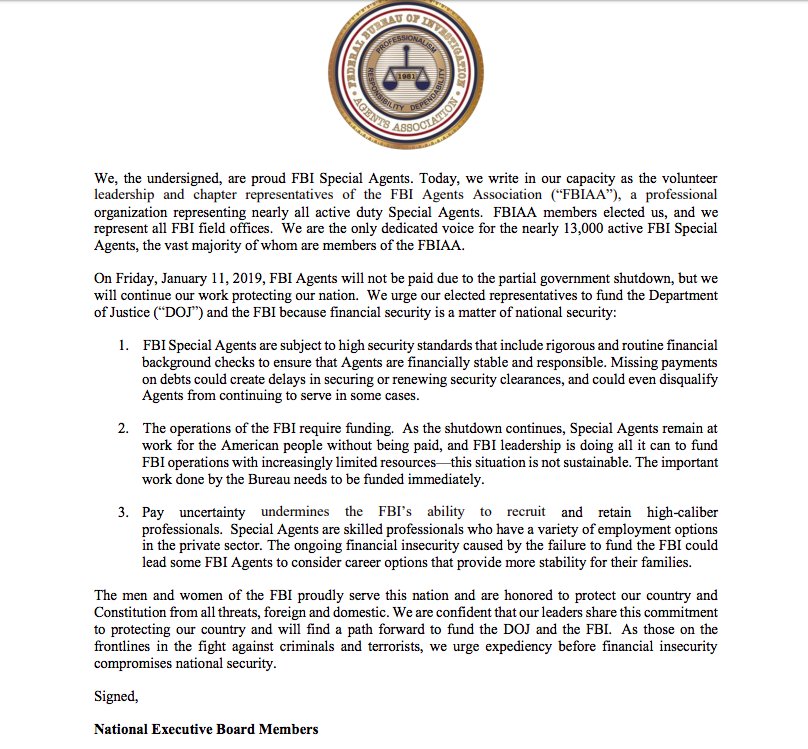
For decades now, ever since Newt Gingrich and House Republicans tried to force their Contract on America through Congress, a series of federal govenment shutdowns have illustrated the stark asymmetry between the two main political parties. Republicans are willing to impose shutdowns because they are basically opposed to the federal government with the sole exception of the military and federal law enforcement. In game theory terms, Republicans only care about the effects of a shutdown on the next election, which tend to be quite limited. For Trump, who is unpopular and conducts himself as the president of his base rather than the nation, the shutdown affords a perfect opportunity to assert his absolute dominance over national politics. And Mitch McConnell is more than willing to assist. The added benefit for Trump in this case is that strangling the federal government eventually hurts the special counsel investigations into his presidential campaign, the transition, and the conduct of the president and members of his administration.
Speaking of strangling the important work of the federal government:
Tuesday, February 6, 2018
The Middle Ground is Unsafe
Josh Marshall makes an important point in The GOP and Big Lie Politics:
"The biggest impact of the Nunes Memo – and the accompanying wave of propaganda – is that conventional news and commentary is incapable of handling willful lying in the public sphere. This is a pattern we’ve seen again and again. It’s one of the hallmarks of this political age. It’s worth saying it again: conventional media is not equipped to deal with willful lying in the public sphere."
In this piece on Talkingpointsmemo, Marshall distinguishes between Fox's propagandistic reporting and reality-based reporting. His first example of faulty reality-based coverage is Chris Cillizza . We have called out problems with Cillizza's reporting in Running on Empty and Confusion about Confusion. The problem with Cillizza is a tendency to lean to the middle in his analysis, which is similar to false balance. False balance dictates that if you have a story that presents a narrative that seems to favor an outlook that is more to the left, then, as an "objective" reporter, you need to offer up your own arguments that might come from the "other side", regardless of your own assessment of the reality. So it is a matter of saying - "here is the story from the left, but here is the story from the right." And the implication for the reader is OK, here are two stories and you decide which is faithful to the truth.
The problem with Cillizza is, like some other pundits, the inclination to head straight to a narrative that hugs the middle - sort of like the "Third Way".
TPM quotes Cillizza on CNN today:
"I think ultimately – I’m actually with [former Trump advisor Jason Miller] in that – I don’t know that either of these [memos] are the smoking gun that either side wanted. I know conservatives insist the Nunes memo – I shouldn’t lump them together – some conservatives think the Nunes memo, now that it has been released, proves once and for all that everything is totally fine and that Donald Trump is exonerated. I don’t think that’s so. I don’t think the Schiff memo is going to say, oh, my gosh, here it is, the smoking gun we have been waiting for."
But that mischaracterizes the reality by presenting a case of two dueling memos that start equally out of the gate, are both to be taken seriously on their own terms, and then the public decides what to believe based on these memos. The Democrat's memo was only necessitated by the Nunes memo. Democrats did not want to have to write any such memo. They are concerned with the danger of releasing classified information solely for rank political purpose. Nunes, of course, had to recuse himself early in the investigatory process when he was caught collaborating with the White House even as he was charged as head of the committee with leading the investigation. And so on. In this environment, Cillizza feels compelled to navigate to the middle.
TPM does not quite capture the worst problems with Cillizza, but Marshall's explanation of the problem of the reality-based press is expressed well, reading in part:
"This is actually quite black and white. There’s no evidence of politicized intelligence or law enforcement or counter-intelligence work at all. Actually not any. All the evidence is based on false claims, logical fallacies or intentionally misleading representations of how standard law enforcement procedures work. There’s also a high brow version of this which redirects the conversation toward longstanding and legitimate concerns about whether the FISA system is consistent with the rule of law in the first place. This is a grave error which only confuses the situation and makes general considerations about the rule of law into a tool of someone trying to trample on it."
By insisting on balance in reporting or, as in the Cillizza case, reporting directly from the middle as somehow representing the "safe ground", reality-based reporters, even while acting in good faith, fail miserably because bad actors - think Fox News - can so easily outmaneuver their definition of objective journalism.
Another recent example of the weakness of the objective journalists is illustrated by the NYT piece:
How Our Reporter Uncovered a Lie That Propelled an Alt-Right Extremists Rise
Despite recent history the Times still believes that calling out a lie matters - in this case, a neo-nazi's lie claiming military service in Iraq and doubling down on the lie when caught (remind you of anyone?) As if that matters. The nazi's followers are supposed to care about the lie and, what, ask him about it? Stop following him? Stop being neo-nazis? Sorry NYT, that is not how this works. He got himself a profile in the Times. That's all that matters.
What did the Times expect?
The Times reporter tells us:
I had pictured the phone call going a lot of different ways, but I hadn’t quite prepared for this.
I thought he might swear at me and then hang up. Maybe he would try to turn the conversation around, attacking me and the credibility of The New York Times. Or maybe he would become contrite and emotional, and finally answer some real questions. But I never thought he would just deny it."
Contrite and emotional? Really?
Unfortunately, at the NYT, reporters are slow learners. They have been so steeped in their belief of a rational universe, that they can not believe that the world is populated by vast numbers of basically irrational people who begin with a strongly held belief and then collect facts (or lies, it doesn't matter which) to support that belief and who feel free to rely on logical fallacies to inform their views.
Will the NYT ever learn? Will Chris Cillizza? Not likely. Not any time soon.
"The biggest impact of the Nunes Memo – and the accompanying wave of propaganda – is that conventional news and commentary is incapable of handling willful lying in the public sphere. This is a pattern we’ve seen again and again. It’s one of the hallmarks of this political age. It’s worth saying it again: conventional media is not equipped to deal with willful lying in the public sphere."
In this piece on Talkingpointsmemo, Marshall distinguishes between Fox's propagandistic reporting and reality-based reporting. His first example of faulty reality-based coverage is Chris Cillizza . We have called out problems with Cillizza's reporting in Running on Empty and Confusion about Confusion. The problem with Cillizza is a tendency to lean to the middle in his analysis, which is similar to false balance. False balance dictates that if you have a story that presents a narrative that seems to favor an outlook that is more to the left, then, as an "objective" reporter, you need to offer up your own arguments that might come from the "other side", regardless of your own assessment of the reality. So it is a matter of saying - "here is the story from the left, but here is the story from the right." And the implication for the reader is OK, here are two stories and you decide which is faithful to the truth.
The problem with Cillizza is, like some other pundits, the inclination to head straight to a narrative that hugs the middle - sort of like the "Third Way".
TPM quotes Cillizza on CNN today:
"I think ultimately – I’m actually with [former Trump advisor Jason Miller] in that – I don’t know that either of these [memos] are the smoking gun that either side wanted. I know conservatives insist the Nunes memo – I shouldn’t lump them together – some conservatives think the Nunes memo, now that it has been released, proves once and for all that everything is totally fine and that Donald Trump is exonerated. I don’t think that’s so. I don’t think the Schiff memo is going to say, oh, my gosh, here it is, the smoking gun we have been waiting for."
But that mischaracterizes the reality by presenting a case of two dueling memos that start equally out of the gate, are both to be taken seriously on their own terms, and then the public decides what to believe based on these memos. The Democrat's memo was only necessitated by the Nunes memo. Democrats did not want to have to write any such memo. They are concerned with the danger of releasing classified information solely for rank political purpose. Nunes, of course, had to recuse himself early in the investigatory process when he was caught collaborating with the White House even as he was charged as head of the committee with leading the investigation. And so on. In this environment, Cillizza feels compelled to navigate to the middle.
TPM does not quite capture the worst problems with Cillizza, but Marshall's explanation of the problem of the reality-based press is expressed well, reading in part:
"This is actually quite black and white. There’s no evidence of politicized intelligence or law enforcement or counter-intelligence work at all. Actually not any. All the evidence is based on false claims, logical fallacies or intentionally misleading representations of how standard law enforcement procedures work. There’s also a high brow version of this which redirects the conversation toward longstanding and legitimate concerns about whether the FISA system is consistent with the rule of law in the first place. This is a grave error which only confuses the situation and makes general considerations about the rule of law into a tool of someone trying to trample on it."
By insisting on balance in reporting or, as in the Cillizza case, reporting directly from the middle as somehow representing the "safe ground", reality-based reporters, even while acting in good faith, fail miserably because bad actors - think Fox News - can so easily outmaneuver their definition of objective journalism.
Another recent example of the weakness of the objective journalists is illustrated by the NYT piece:
How Our Reporter Uncovered a Lie That Propelled an Alt-Right Extremists Rise
Despite recent history the Times still believes that calling out a lie matters - in this case, a neo-nazi's lie claiming military service in Iraq and doubling down on the lie when caught (remind you of anyone?) As if that matters. The nazi's followers are supposed to care about the lie and, what, ask him about it? Stop following him? Stop being neo-nazis? Sorry NYT, that is not how this works. He got himself a profile in the Times. That's all that matters.
What did the Times expect?
The Times reporter tells us:
I had pictured the phone call going a lot of different ways, but I hadn’t quite prepared for this.
I thought he might swear at me and then hang up. Maybe he would try to turn the conversation around, attacking me and the credibility of The New York Times. Or maybe he would become contrite and emotional, and finally answer some real questions. But I never thought he would just deny it."
Contrite and emotional? Really?
Unfortunately, at the NYT, reporters are slow learners. They have been so steeped in their belief of a rational universe, that they can not believe that the world is populated by vast numbers of basically irrational people who begin with a strongly held belief and then collect facts (or lies, it doesn't matter which) to support that belief and who feel free to rely on logical fallacies to inform their views.
Will the NYT ever learn? Will Chris Cillizza? Not likely. Not any time soon.
Wednesday, January 31, 2018
But I'm a Republican!
What's happening in America today is like a slow motion train wreck when the engineer is drunk, the brakes fail, and the cars head toward a bridge that has just collapsed into a lake. When so much goes wrong at once, if we try to understand what happened, the blow by blow of the cars collapsing on one another as they plunge into the lake does not help us understand.
Much of our current political analysis goes into detail about the awfulness of the current situation, but separating the key elements of the continuing tragedy from other significant factors is difficult, now that so much has gone wrong. Some commentators finish their essays with "This will not end well." But a fair question to that would be - "What makes you so sure this will end?".
Amanda Carpenter writes in Politico "I'm a Republican. Why is My Party Gaslighting America?" OK, but a better question might be, "What Took You So Long to Notice?". Carpenter was communications director for Ted Cruz and wrote speeches for Jim DeMint.
One problem is the title of the piece. Saying "I'm a Republican" is supposed to lend greater credibility to Carpenter than we should afford any person who is a Democrat because she is supposedly going against an established bias. But that logic fails in several ways. The same logic argues that she worked for Ted Cruz, who was the last man standing in the Republican presidential primaries against Trump. The article even notes Trump's attack on Cruz's father, but could also note the attacks on Cruz' wife. If "I am a Republican" is supposed to signify credibility, then similar logic can be employed to counter argue "I am a Ted Cruz operative and therefore any of my criticisms of Trump can not be believed." So credibility needs to be based on a record of, well, credibility, not membership in a particular group.
And, to take this same point, further - ad nauseum - then Rod Rosenstein can be called a "Democrat from Baltimore", which is false on both counts and lifelong Republican Mueller can be accused of favoring the Democrats. Anyone who challenges those claims is suspect. Which leads to anyone who challenges the current occupant of the White House is suspect. Which is how we lose the rule of law and ultimately end up with an autocracy.
If we want to take note of membership in a particular group, we might better pay attention instead to the fact that Amanda Carpenter is only the latest in a growing list of conservative Republican political operatives and former officeholders who are willing to call out Trump for the horror that he represents. These people are to be believed not because they are Republicans, but because their arguments, supported by the facts, make sense!
False balance got us into this mess. Not because balance as a starting point is bad, but balance has its limits. When bad actors are willing to stretch the rules and norms of behavior and behave indecently, efforts at balance become strained. Political reporters ignore known facts and prior and current patterns of behavior. What if this time, everything that is happening is unlike anything that has ever happened in the past? Assuming that is possible - how could that be impossible? - assuming that is possible, forcing balance becomes false and provides support for deliberately false narratives. The false narrative is taken seriously, sucking energy away from truthful narratives, effectively equating a web of lies with a carefully developed honest story.
Nevertheless the Carpenter article is helpful because it adds to the growing chorus of Republican operatives who are quite conservative, complaining about the Republican-led Congress that is ditching democratic institutions in order to buttress the looming Trumpian autocracy. And Carpenter makes a valuable contribution to public understanding by noting Trump's use of vagueness as a weapon in his arsenal - referring to Trump's penchant throughout his career of "casting vague aspersions". Vague accusations are tougher to rebut precisely due to their vagueness.
And finally she highlights the use of the false narrative as a weapon. When the truth is your enemy, only false narrative can save you. In the case of Trump, there is no detailed story that is any way believable and supported by evidence that can depict him as an innocent party. The only way to buttress his story is to avoid telling it completely and distract with lengthy conspiracy theories about anyone who opposes him. Obama. Clinton. That worked for a while, but is being stretched thin. So it became Comey and McCabe. But that is not enough. Rosenstein is at risk and, of course, Mueller. For anyone who has not himself committed crimes, supporting Trump through all of this requires an observer to ignore this Trumpian pattern of behavior that has extended to Republicans in Congress.
This is not going well.
Next up: Suspending the 2018 elections as a "temporary" measure.
Much of our current political analysis goes into detail about the awfulness of the current situation, but separating the key elements of the continuing tragedy from other significant factors is difficult, now that so much has gone wrong. Some commentators finish their essays with "This will not end well." But a fair question to that would be - "What makes you so sure this will end?".
Amanda Carpenter writes in Politico "I'm a Republican. Why is My Party Gaslighting America?" OK, but a better question might be, "What Took You So Long to Notice?". Carpenter was communications director for Ted Cruz and wrote speeches for Jim DeMint.
One problem is the title of the piece. Saying "I'm a Republican" is supposed to lend greater credibility to Carpenter than we should afford any person who is a Democrat because she is supposedly going against an established bias. But that logic fails in several ways. The same logic argues that she worked for Ted Cruz, who was the last man standing in the Republican presidential primaries against Trump. The article even notes Trump's attack on Cruz's father, but could also note the attacks on Cruz' wife. If "I am a Republican" is supposed to signify credibility, then similar logic can be employed to counter argue "I am a Ted Cruz operative and therefore any of my criticisms of Trump can not be believed." So credibility needs to be based on a record of, well, credibility, not membership in a particular group.
And, to take this same point, further - ad nauseum - then Rod Rosenstein can be called a "Democrat from Baltimore", which is false on both counts and lifelong Republican Mueller can be accused of favoring the Democrats. Anyone who challenges those claims is suspect. Which leads to anyone who challenges the current occupant of the White House is suspect. Which is how we lose the rule of law and ultimately end up with an autocracy.
If we want to take note of membership in a particular group, we might better pay attention instead to the fact that Amanda Carpenter is only the latest in a growing list of conservative Republican political operatives and former officeholders who are willing to call out Trump for the horror that he represents. These people are to be believed not because they are Republicans, but because their arguments, supported by the facts, make sense!
False balance got us into this mess. Not because balance as a starting point is bad, but balance has its limits. When bad actors are willing to stretch the rules and norms of behavior and behave indecently, efforts at balance become strained. Political reporters ignore known facts and prior and current patterns of behavior. What if this time, everything that is happening is unlike anything that has ever happened in the past? Assuming that is possible - how could that be impossible? - assuming that is possible, forcing balance becomes false and provides support for deliberately false narratives. The false narrative is taken seriously, sucking energy away from truthful narratives, effectively equating a web of lies with a carefully developed honest story.
Nevertheless the Carpenter article is helpful because it adds to the growing chorus of Republican operatives who are quite conservative, complaining about the Republican-led Congress that is ditching democratic institutions in order to buttress the looming Trumpian autocracy. And Carpenter makes a valuable contribution to public understanding by noting Trump's use of vagueness as a weapon in his arsenal - referring to Trump's penchant throughout his career of "casting vague aspersions". Vague accusations are tougher to rebut precisely due to their vagueness.
And finally she highlights the use of the false narrative as a weapon. When the truth is your enemy, only false narrative can save you. In the case of Trump, there is no detailed story that is any way believable and supported by evidence that can depict him as an innocent party. The only way to buttress his story is to avoid telling it completely and distract with lengthy conspiracy theories about anyone who opposes him. Obama. Clinton. That worked for a while, but is being stretched thin. So it became Comey and McCabe. But that is not enough. Rosenstein is at risk and, of course, Mueller. For anyone who has not himself committed crimes, supporting Trump through all of this requires an observer to ignore this Trumpian pattern of behavior that has extended to Republicans in Congress.
This is not going well.
Next up: Suspending the 2018 elections as a "temporary" measure.
Thursday, January 25, 2018
Tomorrow is Another Day and Tomorrow Never Comes
"Trump surprises his lawyers and alarms his friends by saying he will talk with Mueller" reads the seemingly innocuous headline in WaPo. But a more accurate headline would say "Trump surprises no one by saying he will talk with Mueller."
Such proclamations from Trump fit a pattern of behavior. When he seems cornered and may even feel cornered, he makes whatever statement which, coming from him, would, if true, best serve his interests. He makes these statements without regard to future events or actual intent, knowing full well that the traditional rules that apply to anyone else do not apply to him. His support is based on faith and the full support of so-called Fox News. No supporter is ever going to hold him to his word.
Presenting himself as eager to talk to Mueller makes him appear both positive and innocent to his supporters and comes at no cost because he will not be held accountable later if he refuses to testify and gives any reason, however implausible, for that refusal. The WaPo piece mentions that the tax returns have never been produced speaking of a "Houdini-like willingness to wiggle out of commitments." But there is a method to this madness:
An implausible and nonsensical excuse for not doing something is more powerful than a reasonable justification - by being illogical, it is irrefutable with logic
Why? Because a reasonable justification can be refuted with reason, with logic and lead to a sensible back-and-forth rational discussion. But Trump survives on illogic and fallacy. There is no way to make rational arguments against irrationality. If supporters are willing to ignore rationality, Trump can get away with this forever.
Take the Trump tweet of May 12, 2017
James Comey better hope that there are no "tapes" of our conversations before he starts leaking to the press!
Even though this tweet fits the Trumpian pattern of endless lies and obfuscation - backed into a corner, he comes out with a distracting statement, a justification for the present or a promise for the future built upon a lie. If you think of Trump as anything like a rational human being, which he is not, you can't help but think - "Oh, so there may be a record of some kind, not exactly tapes, but objective evidence that would make Comey out to be a liar." Just sending us down that road serves the purpose of the day. For Trump, there is no tomorrow to worry about.
For whatever tomorrow brings will just mean a new and different lie - a "surprising" statement according to our reality based, but still often clueless press. In a sane world, Trump would always be presumed lying with every statement he makes and, if at a later date, he was found not to be lying, then the headline would read "The Time That Trump Was Not Lying."
Such proclamations from Trump fit a pattern of behavior. When he seems cornered and may even feel cornered, he makes whatever statement which, coming from him, would, if true, best serve his interests. He makes these statements without regard to future events or actual intent, knowing full well that the traditional rules that apply to anyone else do not apply to him. His support is based on faith and the full support of so-called Fox News. No supporter is ever going to hold him to his word.
Presenting himself as eager to talk to Mueller makes him appear both positive and innocent to his supporters and comes at no cost because he will not be held accountable later if he refuses to testify and gives any reason, however implausible, for that refusal. The WaPo piece mentions that the tax returns have never been produced speaking of a "Houdini-like willingness to wiggle out of commitments." But there is a method to this madness:
An implausible and nonsensical excuse for not doing something is more powerful than a reasonable justification - by being illogical, it is irrefutable with logic
Why? Because a reasonable justification can be refuted with reason, with logic and lead to a sensible back-and-forth rational discussion. But Trump survives on illogic and fallacy. There is no way to make rational arguments against irrationality. If supporters are willing to ignore rationality, Trump can get away with this forever.
Take the Trump tweet of May 12, 2017
James Comey better hope that there are no "tapes" of our conversations before he starts leaking to the press!
Even though this tweet fits the Trumpian pattern of endless lies and obfuscation - backed into a corner, he comes out with a distracting statement, a justification for the present or a promise for the future built upon a lie. If you think of Trump as anything like a rational human being, which he is not, you can't help but think - "Oh, so there may be a record of some kind, not exactly tapes, but objective evidence that would make Comey out to be a liar." Just sending us down that road serves the purpose of the day. For Trump, there is no tomorrow to worry about.
For whatever tomorrow brings will just mean a new and different lie - a "surprising" statement according to our reality based, but still often clueless press. In a sane world, Trump would always be presumed lying with every statement he makes and, if at a later date, he was found not to be lying, then the headline would read "The Time That Trump Was Not Lying."
Tuesday, November 28, 2017
When Both Sides Don't Do It
David Leonhardt has an interesting piece in NYT with a proper focus on Republican party tactics to advance the proposed tax legislation: The Four Big Tax Deceptions
1. Describe the benefits of a different tax plan and make it sound as if they are talking about this one. I would lump this tactic together with calling the proposal "tax reform" as if it somehow goes beyond tax cuts aimed at the wealthy, which is in sharp contrast to the 1986 Tax Reform Act which broadened the tax base by closing many loopholes that had evolved over the years while lowering the top tax rates on individuals.
2. Talk about the plan's middle class tax cuts - and ignore the middle class tax increases
3. Pretend that the future will never arrive. Krugman in "The Biggest Tax Scam in History" (along with others) puts this a little more accurately. Make two arguments, each of which can be true in a given context, but both of which can not be simultaneously true: "Here’s how it works: If you point out that the bill hugely favors the wealthy at the expense of ordinary families, Republicans will point to the next few years, when the class-war nature of the plan is obscured by those temporary tax breaks — and claim that whatever the language of the law says, those tax breaks will actually be made permanent by later Congresses.
But if you point out that the bill is fiscally irresponsible, they’ll say that it “only” raises the deficit by $1.5 trillion over the next decade and doesn’t raise deficits at all after that — because, you see, those tax breaks will expire by 2027, so the tax hikes will raise a lot of revenue."
4. Rush, rush, rush. This one is a big a red flag. Rush, rush, rush before anyone has time to notice and better understand your tactics in 1, 2 and 3 above. Of course, rush, rush, rush was the tactic of choice used for the push to repeal the ACA.
What all this adds up to is the "Silver Bullet" approach to government. Do whatever you want and make any claim that supports your desired action, whether or not true so long as the claim you make is the claim which, if true, would or might support your action. And, whether or not true, may not be relevant, but if irrelevant, would crowd out meaningful consideration of relevant policy details.
Is it any wonder that the Republican president lies all the time?
The Silver Bullet is also used in electoral campaigns including the permanent campaign pursued by the Trump administration. So the president argued in the campaign that he could not release his tax returns because he was under audit. That was a patently false statement, but it was a statement. The fact of the audit was irrelevant. He did not provide additional detail which would have been refutable. End of discussion. Mission accomplished.
So a visit by the few surviving Navajo code talkers is used as a campaign event to insult those White House guests with a "Pocohantas" jab, ostensibly aimed at Warren, but really used as a deflection. Funny how these moments so often involve people of color.
The Leonhardt piece ends with a mention of the failed Roy Moore scam targeted as the Washington Post. Suppose the scammer had been able to obtain video footage of the meeting with WaPo that could be sliced to place Wapo in a damaging light, whether or not fairly. That footage would be the Silver Bullet discrediting the Post, even though that particular footage would still be irrelevant to the guilt or innocence of Roy Moore of the charges brought by his accusers to date. Logical fallacies are of no concern to this crew and, no, both sides don't do it. Not like this. [Late update: the post-truth scammer doctored - whoops, I mean heavily edited - the tapes per Wapo here.]
An interesting sidebar to all this is the number of staunch Republicans -pundits and former officeholders - who find the current administration completely abhorrent. To name a few - George Will, Steve Schmidt, Bruce Bartlett, Joe Scarborough, Mary Matalin, and many others. There is literally no precedent to the level of distress among party loyalists to an administration of their own party. In the decades preceding the electoral success of Trump, the Republican strategy consisted of saying almost anything and using hardball tactics during election campaigns, but pivoting to a softer tone while in office even while employing three-card-monte tactics now and then. An example would be the GW Bush 2001 Commission to Strengthen Social Security with members drawn from both parties, but which was stacked with advocates of private accounts.

When Tactics Become Policy refers in part to this post-1970 Republican game and the fact that when winning is all that matters, the tactics used to win elections or to win Congressional votes on policy matters inevitably end up distorting those policies, sometimes beyond recognition. In fact, the outcome ends up being a situation that absolutely no one ever wanted.
Unless your name is Vladimir Putin. Or Donald Trump.
1. Describe the benefits of a different tax plan and make it sound as if they are talking about this one. I would lump this tactic together with calling the proposal "tax reform" as if it somehow goes beyond tax cuts aimed at the wealthy, which is in sharp contrast to the 1986 Tax Reform Act which broadened the tax base by closing many loopholes that had evolved over the years while lowering the top tax rates on individuals.
2. Talk about the plan's middle class tax cuts - and ignore the middle class tax increases
3. Pretend that the future will never arrive. Krugman in "The Biggest Tax Scam in History" (along with others) puts this a little more accurately. Make two arguments, each of which can be true in a given context, but both of which can not be simultaneously true: "Here’s how it works: If you point out that the bill hugely favors the wealthy at the expense of ordinary families, Republicans will point to the next few years, when the class-war nature of the plan is obscured by those temporary tax breaks — and claim that whatever the language of the law says, those tax breaks will actually be made permanent by later Congresses.
But if you point out that the bill is fiscally irresponsible, they’ll say that it “only” raises the deficit by $1.5 trillion over the next decade and doesn’t raise deficits at all after that — because, you see, those tax breaks will expire by 2027, so the tax hikes will raise a lot of revenue."
4. Rush, rush, rush. This one is a big a red flag. Rush, rush, rush before anyone has time to notice and better understand your tactics in 1, 2 and 3 above. Of course, rush, rush, rush was the tactic of choice used for the push to repeal the ACA.
What all this adds up to is the "Silver Bullet" approach to government. Do whatever you want and make any claim that supports your desired action, whether or not true so long as the claim you make is the claim which, if true, would or might support your action. And, whether or not true, may not be relevant, but if irrelevant, would crowd out meaningful consideration of relevant policy details.
Is it any wonder that the Republican president lies all the time?
The Silver Bullet is also used in electoral campaigns including the permanent campaign pursued by the Trump administration. So the president argued in the campaign that he could not release his tax returns because he was under audit. That was a patently false statement, but it was a statement. The fact of the audit was irrelevant. He did not provide additional detail which would have been refutable. End of discussion. Mission accomplished.
So a visit by the few surviving Navajo code talkers is used as a campaign event to insult those White House guests with a "Pocohantas" jab, ostensibly aimed at Warren, but really used as a deflection. Funny how these moments so often involve people of color.
The Leonhardt piece ends with a mention of the failed Roy Moore scam targeted as the Washington Post. Suppose the scammer had been able to obtain video footage of the meeting with WaPo that could be sliced to place Wapo in a damaging light, whether or not fairly. That footage would be the Silver Bullet discrediting the Post, even though that particular footage would still be irrelevant to the guilt or innocence of Roy Moore of the charges brought by his accusers to date. Logical fallacies are of no concern to this crew and, no, both sides don't do it. Not like this. [Late update: the post-truth scammer doctored - whoops, I mean heavily edited - the tapes per Wapo here.]
An interesting sidebar to all this is the number of staunch Republicans -pundits and former officeholders - who find the current administration completely abhorrent. To name a few - George Will, Steve Schmidt, Bruce Bartlett, Joe Scarborough, Mary Matalin, and many others. There is literally no precedent to the level of distress among party loyalists to an administration of their own party. In the decades preceding the electoral success of Trump, the Republican strategy consisted of saying almost anything and using hardball tactics during election campaigns, but pivoting to a softer tone while in office even while employing three-card-monte tactics now and then. An example would be the GW Bush 2001 Commission to Strengthen Social Security with members drawn from both parties, but which was stacked with advocates of private accounts.

When Tactics Become Policy refers in part to this post-1970 Republican game and the fact that when winning is all that matters, the tactics used to win elections or to win Congressional votes on policy matters inevitably end up distorting those policies, sometimes beyond recognition. In fact, the outcome ends up being a situation that absolutely no one ever wanted.
Unless your name is Vladimir Putin. Or Donald Trump.
Thursday, October 26, 2017
The Party of Lincoln is Now the Party of Trump
Thomas Edsall has thoughtful piece "The Party of Lincoln is Now the Party of Trump" in the NYT today about the extent to which the Republican Party of today is losing its moorings. But his argument fall short in one important sense.
As I comment in the NYT editor's picks:
"The statement that 'Democrats are hardly exempt from tribalism' misses the larger point. No prominent Republican has stepped forward to repudiate Trump unless they are a former officeholder, current officeholder who has decided not to run for re-election, or member of the conservative pundit class. If you are a Republican Senator or Representative who is not running for reelection, then you are not a "GOP pol who stands up to Trump", Nolan McCarty and Ryan Enos notwithstanding. Standing up means putting yourself on the line."
Unfortunately, waiting for a Republican officeholder in the Senate or House to step forward feels like a doomed exercise. The fact that no one has taken this step is evidence of a consensus political calculation - that there is only downside to being the first and potentially only Republican to take such a risk.
As I comment in the NYT editor's picks:
"The statement that 'Democrats are hardly exempt from tribalism' misses the larger point. No prominent Republican has stepped forward to repudiate Trump unless they are a former officeholder, current officeholder who has decided not to run for re-election, or member of the conservative pundit class. If you are a Republican Senator or Representative who is not running for reelection, then you are not a "GOP pol who stands up to Trump", Nolan McCarty and Ryan Enos notwithstanding. Standing up means putting yourself on the line."
Unfortunately, waiting for a Republican officeholder in the Senate or House to step forward feels like a doomed exercise. The fact that no one has taken this step is evidence of a consensus political calculation - that there is only downside to being the first and potentially only Republican to take such a risk.
From Bush to Trump to What?
As noted previously here and by others, Trump is not an aberration. The Trump phenomenon is the result of a natural progression of corrosive Republican party tactic over recent decades. The Bushes in particular embraced extreme tactics in political campaigns. George H.W. Bush was expert at the pivot from divisive campaign tactics to more normal behavior as president. George W. Bush carried tactical politics to an extreme in both campaigns and governing. Rich Benjamin has a pretty good rundown in the allotted space today in WaPo: George W. Bush is not part of the Resistance. He's part of what brought us Trump.
Benjamin's piece is mostly spot on, but the ending is a bit off; "Americans may like to forget history. But this year is showing us in real time that we are, indeed, doomed to repeat it."
Actually, we are not repeating history. We are experiencing the natural progression of history that happens when tactics employed to win become more important than any other consideration - like survival of the republic.
The Trump phenomenon is more extreme than the Bush phenomenon ever was. Anything bad about Bush is taken to a never-before experienced extreme with Trump. With Trump, literally no one knows where this goes. If the current Republican Congress continues to support Trump, everything has to get worse before it gets better.
Benjamin's piece is mostly spot on, but the ending is a bit off; "Americans may like to forget history. But this year is showing us in real time that we are, indeed, doomed to repeat it."
Actually, we are not repeating history. We are experiencing the natural progression of history that happens when tactics employed to win become more important than any other consideration - like survival of the republic.
The Trump phenomenon is more extreme than the Bush phenomenon ever was. Anything bad about Bush is taken to a never-before experienced extreme with Trump. With Trump, literally no one knows where this goes. If the current Republican Congress continues to support Trump, everything has to get worse before it gets better.
Tuesday, September 26, 2017
Becoming Rational
James Hohmann (with Breanne Deppisch and Joanie Greve) contributes mightily to public dissection of the Trump phenomenon in The Daily 202: Why the divider in chief embraces culture wars.
Finally an article that shines the spotlight on the tools employed by Trump (and other traffickers of logical fallacies.)
"Trump ... has long been a builder of straw men...his chaotic approach to governing also depends on constantly presenting the American people with false binary choices."
Hohmann continues with a description of the recent week of Trump attacks on mostly black NFL players: "Trump talks about the world in black-and-white terms: You’re either with him or against him."
That is actually two salient points in one sentence. As a black and white thinker, Trump's style appeals to black white thinking - never mind that we live in a world of shades of gray. And Trump has built his own world as dependent on unquestioning loyalty. If you are not loyal, you are fired.
After that, the key points continue to be made in bold:
"He is also looking for distractions." (Distractions divert attention from his incompetence and corruption."
"This is part of a pattern." (No kidding. Of course, this was the pattern last year too, but as a candidate, Trump was judged by mainstream media under the rule that if journalists observe a pattern of misbehavior, they must report using the rules of fair and balance - only the opponent of the candidate can make the observation of a pattern of misbehavior. Otherwise, the journalist is being 'biased'. Which is exactly how Trump got away with the misbehavior by being the more aggressive attacker. Observation of patterns of behavior is an important element of accurate factual reporting in context. Without a journalist's noting the pattern, the context is lost and we are left with competing "facts" in support of alternative narratives and no reliable method to discern truth from fiction.)
"Facing blowback over his false moral equivalency after the violence in Charlottesville, Trump embraced the cause of preserving historical statues." The piece continues with "Employing the fallacy of the slippery slope, Trump warned that George Washington and Thomas Jefferson statues would come down next if statues to Stonewall Jackson are taken down."
So the authors take two more shots at the irrationality of faulty logic with "false moral equivalency" and the proverbial "slippery slope". If you don't have a credible argument against your opponent's position, argue against the supposed outcome.
"Picking fights with people like Kaepernick is Trump’s modus operandi. He thrives on feuds, and he likes setting up binary contrasts between himself and others." There you have it again - the world in black and white. No shades of gray.
"A similar dynamic was at play when Trump attacked the Broadway musical “Hamilton” last November after the cast read a statement to Mike Pence celebrating diversity"
The piece continues with other great insights and surmises that this could be Trump's Army vs. McCarthy moment. Maybe, but not likely. For Trump is still controlling the narrative. He shines the spotlight where he wants it and will deflect away from the NFL at a moment's notice. Only when the mainstream media fails to take the bait of the daily tweetstorm will the distractions lose their power. Unfortunately, that result may require dramatic legal action by Mueller and his team.
The Washington Post has done a better job of producing insights on Trump (and Republicans) trafficking in logical fallacies. A significant portion of mainstream outlets, including much (but not all) of the New York Times reporting misses the purely tactical nature of the Trump posture.
One hopes that WaPo and other mainstream outlets will double down on their new rationality so much that whenever a politician says, for example, "Obamacare is a disaster" (which Republicans use as their go to line about health care reform,) those politicians will be called out on the logical fallacy of invoking a frame --hating Obama -- while evading serious discussion of the issues.
And, more than anything else, we need the next election year to be marked by new journalism that recognizes patterns of behavior and reports on real context - context established by observation of clear patterns of behavior rather than he said/she said reporting without context. The true test for journalists will come when the current mode of speaking truth to power with Republicans having taken over all three branches of government and most state houses is replaced by the rules of campaign reporting.
Finally an article that shines the spotlight on the tools employed by Trump (and other traffickers of logical fallacies.)
"Trump ... has long been a builder of straw men...his chaotic approach to governing also depends on constantly presenting the American people with false binary choices."
Hohmann continues with a description of the recent week of Trump attacks on mostly black NFL players: "Trump talks about the world in black-and-white terms: You’re either with him or against him."
That is actually two salient points in one sentence. As a black and white thinker, Trump's style appeals to black white thinking - never mind that we live in a world of shades of gray. And Trump has built his own world as dependent on unquestioning loyalty. If you are not loyal, you are fired.
After that, the key points continue to be made in bold:
"He is also looking for distractions." (Distractions divert attention from his incompetence and corruption."
"This is part of a pattern." (No kidding. Of course, this was the pattern last year too, but as a candidate, Trump was judged by mainstream media under the rule that if journalists observe a pattern of misbehavior, they must report using the rules of fair and balance - only the opponent of the candidate can make the observation of a pattern of misbehavior. Otherwise, the journalist is being 'biased'. Which is exactly how Trump got away with the misbehavior by being the more aggressive attacker. Observation of patterns of behavior is an important element of accurate factual reporting in context. Without a journalist's noting the pattern, the context is lost and we are left with competing "facts" in support of alternative narratives and no reliable method to discern truth from fiction.)
"Facing blowback over his false moral equivalency after the violence in Charlottesville, Trump embraced the cause of preserving historical statues." The piece continues with "Employing the fallacy of the slippery slope, Trump warned that George Washington and Thomas Jefferson statues would come down next if statues to Stonewall Jackson are taken down."
So the authors take two more shots at the irrationality of faulty logic with "false moral equivalency" and the proverbial "slippery slope". If you don't have a credible argument against your opponent's position, argue against the supposed outcome.
"Picking fights with people like Kaepernick is Trump’s modus operandi. He thrives on feuds, and he likes setting up binary contrasts between himself and others." There you have it again - the world in black and white. No shades of gray.
"A similar dynamic was at play when Trump attacked the Broadway musical “Hamilton” last November after the cast read a statement to Mike Pence celebrating diversity"
The piece continues with other great insights and surmises that this could be Trump's Army vs. McCarthy moment. Maybe, but not likely. For Trump is still controlling the narrative. He shines the spotlight where he wants it and will deflect away from the NFL at a moment's notice. Only when the mainstream media fails to take the bait of the daily tweetstorm will the distractions lose their power. Unfortunately, that result may require dramatic legal action by Mueller and his team.
The Washington Post has done a better job of producing insights on Trump (and Republicans) trafficking in logical fallacies. A significant portion of mainstream outlets, including much (but not all) of the New York Times reporting misses the purely tactical nature of the Trump posture.
One hopes that WaPo and other mainstream outlets will double down on their new rationality so much that whenever a politician says, for example, "Obamacare is a disaster" (which Republicans use as their go to line about health care reform,) those politicians will be called out on the logical fallacy of invoking a frame --hating Obama -- while evading serious discussion of the issues.
And, more than anything else, we need the next election year to be marked by new journalism that recognizes patterns of behavior and reports on real context - context established by observation of clear patterns of behavior rather than he said/she said reporting without context. The true test for journalists will come when the current mode of speaking truth to power with Republicans having taken over all three branches of government and most state houses is replaced by the rules of campaign reporting.
Wednesday, September 13, 2017
When Old News is New Again
I am always suspicious when new news about an old story that has been beaten to death breaks in the midst of a separate and independent, but related event. Huh? What in the world does that mean?
Well, back in the 1960s, 1970s, and 1980s, before sensitivity to Cristobal Colombo's slave trading tendencies emerged, the annual Columbus Day celebration seemed to coincide with an amazing new discovery of a previously unknown mariner's map of the New World or some discovery about Leif Erickson. Newspapers would breathlessly report the amazing new find.
In Boston, the costliest art heist ever occurred in the early morning hours after St. Patrick's Day of 1990. The case of the Isabella Stewart Gardner robbery of works by Rembrandt, Vermeer, and Degas was never solved. Sure enough, what seems like every year, a sudden and promising break in the investigation occurs around St. Patrick's Day. Just in time for breathless reportage.
And so it is no surprise, that the breaking story at Fox News shortly after the publication of Hillary Clinton's book about the 2016 campaign is none other than an "exclusive report" on Benghazi.
We do not know who the next Democratic Presidential nominee will be, but as 2020 draws closer, we know that Fox News will feature stories alleging heinous acts committed by that candidate.
Well, back in the 1960s, 1970s, and 1980s, before sensitivity to Cristobal Colombo's slave trading tendencies emerged, the annual Columbus Day celebration seemed to coincide with an amazing new discovery of a previously unknown mariner's map of the New World or some discovery about Leif Erickson. Newspapers would breathlessly report the amazing new find.
In Boston, the costliest art heist ever occurred in the early morning hours after St. Patrick's Day of 1990. The case of the Isabella Stewart Gardner robbery of works by Rembrandt, Vermeer, and Degas was never solved. Sure enough, what seems like every year, a sudden and promising break in the investigation occurs around St. Patrick's Day. Just in time for breathless reportage.
And so it is no surprise, that the breaking story at Fox News shortly after the publication of Hillary Clinton's book about the 2016 campaign is none other than an "exclusive report" on Benghazi.
We do not know who the next Democratic Presidential nominee will be, but as 2020 draws closer, we know that Fox News will feature stories alleging heinous acts committed by that candidate.
Sunday, August 6, 2017
Not So Fast
Many of our pundit class misunderstood the Trump phenomenon - and that confusion continues, at least for those who buy into Matt Latimer's "What If Trump Had Won As a Democrat". Asking that question misses the point - that Trump won as a Republican by taking tried and proven Republican campaign tactics to their logical extreme conclusion. Personal attacks carried to extreme, irrational levels of viciousness. Attacks on the press, including threatening speech aimed at individual reporters at rallies. And lying as a tactic some of the time taken to the extreme of lying with abandon.
Now Latimer's piece may well be a parody, but serves at least a deflection for Republicans who like their party electoral strategy just fine, thank you, and do not see any need for reform, other than to regard Trump as an aberration instead of the epitome that he is.
Jonathan Chait takes down the Latimer arguments, such as they are, in "Could Trump Have Been Elected As a Democrat?" which is accompanied by a fitting photo that implies an equally 'interesting' thought experiment, "could Palin have been selected for VP as a Democrat?":

Chait writes, "Trump is a product of a decades-long evolution in the Republican Party." And he closes with "Trump is an historical outlier. But he is also the product of the political culture of a Republican Party that is fertile soil for his brand of authoritarian ethno-nationalism. The desire to regard him as a fluke who could just as easily have wound up in the other party is the kind of evasion that has prevented many Republican elites from squaring up to the forces that enabled Trump’s rise."
Unfortunately, those who do not understand their own party history are poorly positioned to make a course correction, let alone reverse course.
Now Latimer's piece may well be a parody, but serves at least a deflection for Republicans who like their party electoral strategy just fine, thank you, and do not see any need for reform, other than to regard Trump as an aberration instead of the epitome that he is.
Jonathan Chait takes down the Latimer arguments, such as they are, in "Could Trump Have Been Elected As a Democrat?" which is accompanied by a fitting photo that implies an equally 'interesting' thought experiment, "could Palin have been selected for VP as a Democrat?":

Chait writes, "Trump is a product of a decades-long evolution in the Republican Party." And he closes with "Trump is an historical outlier. But he is also the product of the political culture of a Republican Party that is fertile soil for his brand of authoritarian ethno-nationalism. The desire to regard him as a fluke who could just as easily have wound up in the other party is the kind of evasion that has prevented many Republican elites from squaring up to the forces that enabled Trump’s rise."
Unfortunately, those who do not understand their own party history are poorly positioned to make a course correction, let alone reverse course.
Monday, July 24, 2017
The Puppet Master
One element of the deny, deflect, distract, accuse tactic when employed by Trump is his instinct for the accusation against his opponent to tie back to the original denial that he has done anything wrong. See The Trumpian Way for details.

For example, in denying wrongdoing with his slippery accusation about Obama's place of birth, Trump progressed to an accusation that Hillary Clinton was responsible for the accusation. That accusation served an important role - to replace the frame of whether or not Trump made the accusation with Clinton and whether or not she made the accusation. After that point, no amount of fact checking can remove the frame. At worst, the accusation can leave an open question - maybe it was Trump, but maybe it was Clinton.
Trump has been rather desperately applying his customary tactics in the current Trump/Russia investigations. His current DDDA tactic resorts to accusing HRC of working with the Russians. No surprise there. But during the 2016 campaign, the playing field was a bit different. Though Clinton her campaign accused Russia of meddling and the U.S. intelligence agencies made that finding, the fact of Russian interference had not caught on in the popular imagination as much as it has today. So Trump's on-the-fly reaction during the final debate is telling:
"TRUMP: That was a great pivot off the fact that she wants open borders, OK? How did we get on to Putin?
...[back and forth and other topics]
Now we can talk about Putin. I don't know Putin. He said nice things about me. If we got along well, that would be good. If Russia and the United States got along well and went after ISIS, that would be good.
He has no respect for her. He has no respect for our president. And I'll tell you what: We're in very serious trouble, because we have a country with tremendous numbers of nuclear warheads -- 1,800, by the way -- where they expanded and we didn't, 1,800 nuclear warheads. And she's playing chicken. Look, Putin...
WALLACE: Wait, but...
TRUMP: ... from everything I see, has no respect for this person.
CLINTON: Well, that's because he'd rather have a puppet as president of the United States.
TRUMP: No puppet. No puppet.
CLINTON: And it's pretty clear...
TRUMP: You're the puppet!
CLINTON: It's pretty clear you won't admit...
TRUMP: No, you're the puppet.
CLINTON: ... that the Russians have engaged in cyberattacks against the United States of America, that you encouraged espionage against our people, that you are willing to spout the Putin line, sign up for his wish list, break up NATO, do whatever he wants to do, and that you continue to get help from him, because he has a very clear favorite in this race.
So I think that this is such an unprecedented situation. We've never had a foreign government trying to interfere in our election. We have 17 -- 17 intelligence agencies, civilian and military, who have all concluded that these espionage attacks, these cyberattacks, come from the highest levels of the Kremlin and they are designed to influence our election. I find that deeply disturbing.
WALLACE: Secretary Clinton...
CLINTON: And I think it's time you take a stand...
TRUMP: She has no idea whether it's Russia, China, or anybody else.
CLINTON: I am not quoting myself.
TRUMP: She has no idea.
CLINTON: I am quoting 17...
TRUMP: Hillary, you have no idea.
CLINTON: ... 17 intelligence -- do you doubt 17 military and civilian...
TRUMP: And our country has no idea.
CLINTON: ... agencies.
TRUMP: Yeah, I doubt it. I doubt it.
CLINTON: Well, he'd rather believe Vladimir Putin than the military and civilian intelligence professionals who are sworn to protect us. I find that just absolutely...
(CROSSTALK)
TRUMP: She doesn't like Putin because Putin has outsmarted her at every step of the way.
WALLACE: Mr. Trump...
TRUMP: Excuse me. Putin has outsmarted her in Syria.
WALLACE: Mr. Trump...
(CROSSTALK)
TRUMP: He's outsmarted her every step of the way.
WALLACE: I do get to ask some questions.
TRUMP: Yes, that's fine.
WALLACE: And I would like to ask you this direct question. The top national security officials of this country do believe that Russia has been behind these hacks. Even if you don't know for sure whether they are, do you condemn any interference by Russia in the American election?
TRUMP: By Russia or anybody else.
WALLACE: You condemn their interference?
TRUMP: Of course I condemn. Of course I -- I don't know Putin. I have no idea.
WALLACE: I'm not asking -- I'm asking do you condemn?
TRUMP: I never met Putin. This is not my best friend. But if the United States got along with Russia, wouldn't be so bad.
Let me tell you, Putin has outsmarted her and Obama at every single step of the way. Whether it's Syria, you name it. Missiles. Take a look at the "start up" that they signed. The Russians have said, according to many, many reports, I can't believe they allowed us to do this. They create warheads, and we can't. The Russians can't believe it. She has been outsmarted by Putin.
And all you have to do is look at the Middle East. They've taken over. We've spent $6 trillion. They've taken over the Middle East. She has been outsmarted and outplayed worse than anybody I've ever seen in any government whatsoever.
WALLACE: We're a long way away from immigration, but I'm going to let you finish this topic. You got about 45 seconds.
TRUMP: And she always will be.
CLINTON: I -- I find it ironic that he's raising nuclear weapons. This is a person who has been very cavalier, even casual about the use of nuclear weapons. He's..."
Sure, Trump often uses repetition for effect and, in the debate, provides several examples of areas where "Putin outsmarted Clinton or Clinton+Obama", but if, at the time, Trump knew that Putin was responsible for the hack of the Clinton campaign in 2016 and the distribution of the emails, then the accusation fits perfectly into the frame of blaming the Democrat because she and her campaign were outwitted by Putin every step of the way - not only by being vulnerable to the hack, but by not being able to prove that Putin was also responsible for the distribution of the emails.
Though this analysis is not proof of anything, the instinctive Trump pattern of tying the accusation he makes against Clinton back to the subject of the original denial (No puppet, no puppet) suggests that Trump knew,which, of course, would mean that he and his team were guilty of collusion with Russia on the hack and distribution of Clinton campaign emails in the 2016 election.
For example, in denying wrongdoing with his slippery accusation about Obama's place of birth, Trump progressed to an accusation that Hillary Clinton was responsible for the accusation. That accusation served an important role - to replace the frame of whether or not Trump made the accusation with Clinton and whether or not she made the accusation. After that point, no amount of fact checking can remove the frame. At worst, the accusation can leave an open question - maybe it was Trump, but maybe it was Clinton.
Trump has been rather desperately applying his customary tactics in the current Trump/Russia investigations. His current DDDA tactic resorts to accusing HRC of working with the Russians. No surprise there. But during the 2016 campaign, the playing field was a bit different. Though Clinton her campaign accused Russia of meddling and the U.S. intelligence agencies made that finding, the fact of Russian interference had not caught on in the popular imagination as much as it has today. So Trump's on-the-fly reaction during the final debate is telling:
"TRUMP: That was a great pivot off the fact that she wants open borders, OK? How did we get on to Putin?
...[back and forth and other topics]
Now we can talk about Putin. I don't know Putin. He said nice things about me. If we got along well, that would be good. If Russia and the United States got along well and went after ISIS, that would be good.
He has no respect for her. He has no respect for our president. And I'll tell you what: We're in very serious trouble, because we have a country with tremendous numbers of nuclear warheads -- 1,800, by the way -- where they expanded and we didn't, 1,800 nuclear warheads. And she's playing chicken. Look, Putin...
WALLACE: Wait, but...
TRUMP: ... from everything I see, has no respect for this person.
CLINTON: Well, that's because he'd rather have a puppet as president of the United States.
TRUMP: No puppet. No puppet.
CLINTON: And it's pretty clear...
TRUMP: You're the puppet!
CLINTON: It's pretty clear you won't admit...
TRUMP: No, you're the puppet.
CLINTON: ... that the Russians have engaged in cyberattacks against the United States of America, that you encouraged espionage against our people, that you are willing to spout the Putin line, sign up for his wish list, break up NATO, do whatever he wants to do, and that you continue to get help from him, because he has a very clear favorite in this race.
So I think that this is such an unprecedented situation. We've never had a foreign government trying to interfere in our election. We have 17 -- 17 intelligence agencies, civilian and military, who have all concluded that these espionage attacks, these cyberattacks, come from the highest levels of the Kremlin and they are designed to influence our election. I find that deeply disturbing.
WALLACE: Secretary Clinton...
CLINTON: And I think it's time you take a stand...
TRUMP: She has no idea whether it's Russia, China, or anybody else.
CLINTON: I am not quoting myself.
TRUMP: She has no idea.
CLINTON: I am quoting 17...
TRUMP: Hillary, you have no idea.
CLINTON: ... 17 intelligence -- do you doubt 17 military and civilian...
TRUMP: And our country has no idea.
CLINTON: ... agencies.
TRUMP: Yeah, I doubt it. I doubt it.
CLINTON: Well, he'd rather believe Vladimir Putin than the military and civilian intelligence professionals who are sworn to protect us. I find that just absolutely...
(CROSSTALK)
TRUMP: She doesn't like Putin because Putin has outsmarted her at every step of the way.
WALLACE: Mr. Trump...
TRUMP: Excuse me. Putin has outsmarted her in Syria.
WALLACE: Mr. Trump...
(CROSSTALK)
TRUMP: He's outsmarted her every step of the way.
WALLACE: I do get to ask some questions.
TRUMP: Yes, that's fine.
WALLACE: And I would like to ask you this direct question. The top national security officials of this country do believe that Russia has been behind these hacks. Even if you don't know for sure whether they are, do you condemn any interference by Russia in the American election?
TRUMP: By Russia or anybody else.
WALLACE: You condemn their interference?
TRUMP: Of course I condemn. Of course I -- I don't know Putin. I have no idea.
WALLACE: I'm not asking -- I'm asking do you condemn?
TRUMP: I never met Putin. This is not my best friend. But if the United States got along with Russia, wouldn't be so bad.
Let me tell you, Putin has outsmarted her and Obama at every single step of the way. Whether it's Syria, you name it. Missiles. Take a look at the "start up" that they signed. The Russians have said, according to many, many reports, I can't believe they allowed us to do this. They create warheads, and we can't. The Russians can't believe it. She has been outsmarted by Putin.
And all you have to do is look at the Middle East. They've taken over. We've spent $6 trillion. They've taken over the Middle East. She has been outsmarted and outplayed worse than anybody I've ever seen in any government whatsoever.
WALLACE: We're a long way away from immigration, but I'm going to let you finish this topic. You got about 45 seconds.
TRUMP: And she always will be.
CLINTON: I -- I find it ironic that he's raising nuclear weapons. This is a person who has been very cavalier, even casual about the use of nuclear weapons. He's..."
Sure, Trump often uses repetition for effect and, in the debate, provides several examples of areas where "Putin outsmarted Clinton or Clinton+Obama", but if, at the time, Trump knew that Putin was responsible for the hack of the Clinton campaign in 2016 and the distribution of the emails, then the accusation fits perfectly into the frame of blaming the Democrat because she and her campaign were outwitted by Putin every step of the way - not only by being vulnerable to the hack, but by not being able to prove that Putin was also responsible for the distribution of the emails.
Though this analysis is not proof of anything, the instinctive Trump pattern of tying the accusation he makes against Clinton back to the subject of the original denial (No puppet, no puppet) suggests that Trump knew,which, of course, would mean that he and his team were guilty of collusion with Russia on the hack and distribution of Clinton campaign emails in the 2016 election.
Sunday, February 5, 2017
False Equivalence in His Hands
We have criticized the New York Times and other mainstream outlets of perpetrating false balance through the error of false equivalence (here and more generally here) , especially throughout election campaigns - bending over backwards trying to be fair, but ultimately being unfair in the process. Sure, they "speak truth to power" when the more aggressive candidate is elected, but at that point, it's too late.
The deny, distract, deflect, accuse tactic can be used to impose false equivalence to remove logic and therefore meaning from any discussion.
The O'Reilly (if a Republican president can't trust Fox news, who can he trust?) interview with DJT - O'Reilly told Trump that Putin is a killer. Trump's reply: 'You think our country is so innocent?' employs three tactics:
1. Rhetorical question. A rhetorical question is not a statement. A rhetorical question can be misleading, calculated to distract and confuse the issue, but is never, ever false. This highlights one more problem with fact checking as a solution to the failure of news media to professionally and faithfully report political news. DJT could choose to only speak in questions. Unfactcheckable. What do you do? Shrug your shoulders? No. You do this. The Twittersphere erupted with varying interpretations of the Trumpian intent, but that's the point. A feature, not a bug.
2. False Equivalence. DJT thus vaguely equates Putin and Putin's Russia with the U.S. The details are left to the listener, but the implication is clear. The specifics - Putin's brutal murder of journalists and political opponents, including cruel and cynical poison murders - is turned into a more general, open-ended and vague comparison. He is like us in some way. But the important differences between Putin and U.S. presidents, at least prior to 2017, is removed by this rhetorical trick from further discussion.
3. Pivot from the specific to the general. Watch carefully how often a specific topic (Putin kills people) is turned into a generality by the Trump White House in support of the deny/deflect stage of the rhetorical strategy. Wait a second...I thought we were talking about Putin? Watch how vigorously Trump deflects discussion when the subject turns to Putin. I am guessing he has his reasons.
What is the problem with following the rule of journalism that stipulates the practice of false balance?
False balance/false equivalence knocks the wind out of the sails of valid criticism of a politician during a campaign or of a political leader once elected. Suppose we live in a world where Republican presidential candidates have followed a pattern of increasing tendency to
(1) avoid direct discussion of issues, instead
(2) speak in code, and, when elected
(3) hollow out cabinet departments by turning the original mission of the department on its head.
By comparing DJT actions at every turn with Obama actions, such an increasing pattern would be impossible to deduce and criticism is neutered. Once you have framed DJT actions as "just like Obama", which you can achieve on every action if you try hard enough, you have pre-defined your narrative to be "all politicians are alike", which is one more yellow brick on the road to post-truth, post-reality America.

The deny, distract, deflect, accuse tactic can be used to impose false equivalence to remove logic and therefore meaning from any discussion.
The O'Reilly (if a Republican president can't trust Fox news, who can he trust?) interview with DJT - O'Reilly told Trump that Putin is a killer. Trump's reply: 'You think our country is so innocent?' employs three tactics:
1. Rhetorical question. A rhetorical question is not a statement. A rhetorical question can be misleading, calculated to distract and confuse the issue, but is never, ever false. This highlights one more problem with fact checking as a solution to the failure of news media to professionally and faithfully report political news. DJT could choose to only speak in questions. Unfactcheckable. What do you do? Shrug your shoulders? No. You do this. The Twittersphere erupted with varying interpretations of the Trumpian intent, but that's the point. A feature, not a bug.
2. False Equivalence. DJT thus vaguely equates Putin and Putin's Russia with the U.S. The details are left to the listener, but the implication is clear. The specifics - Putin's brutal murder of journalists and political opponents, including cruel and cynical poison murders - is turned into a more general, open-ended and vague comparison. He is like us in some way. But the important differences between Putin and U.S. presidents, at least prior to 2017, is removed by this rhetorical trick from further discussion.
3. Pivot from the specific to the general. Watch carefully how often a specific topic (Putin kills people) is turned into a generality by the Trump White House in support of the deny/deflect stage of the rhetorical strategy. Wait a second...I thought we were talking about Putin? Watch how vigorously Trump deflects discussion when the subject turns to Putin. I am guessing he has his reasons.
What is the problem with following the rule of journalism that stipulates the practice of false balance?
False balance/false equivalence knocks the wind out of the sails of valid criticism of a politician during a campaign or of a political leader once elected. Suppose we live in a world where Republican presidential candidates have followed a pattern of increasing tendency to
(1) avoid direct discussion of issues, instead
(2) speak in code, and, when elected
(3) hollow out cabinet departments by turning the original mission of the department on its head.
By comparing DJT actions at every turn with Obama actions, such an increasing pattern would be impossible to deduce and criticism is neutered. Once you have framed DJT actions as "just like Obama", which you can achieve on every action if you try hard enough, you have pre-defined your narrative to be "all politicians are alike", which is one more yellow brick on the road to post-truth, post-reality America.

Saturday, February 4, 2017
Bowling Green Massacre
George Lakoff, the cognitive linguist, argues for an applied taxonomy to explain Trump Tweets.

This taxonomy aligns closely with our previous discussion of Trump's key tactic when questioned by reporters --- deny, deflect, distract, accuse (DDDA). The perfect example was the sinister birtherism lie .
Our mainstream press allows the more aggressive candidate or officeholder establish the frame. Hillary Clinton was not aggressive, so a questioner like Matt Lauer or Chris Wallace could easily establish the frame, to paraphrase, "How could someone as terrible as you consider yourself qualified to be president?". Trump would follow the DDDA pattern or just swat the question away - "I don't talk about that anymore."
Lakoff's recent interview in Salon hits the nail on the head. Speaking of the Enlightenment reasoning of Descartes:
"So what he [Descartes] said, basically, was that there are no frames, no embodiment, no metaphor — none of the things people really use to reason. Moreover if we think logically and we all have the same reasoning, if you just tell people the facts, they should reason to the same correct conclusion. And that just isn’t true. And that keeps not being true, and liberals keep making the same mistake year after year after year. So that’s a very important thing."
In that interview, he proceeds to identify the Trump success on the level of metaphor and to explain what progressives need to do to frame issues.
But, at least in this discussion, Lakoff does not identify what mainstream journalists need to stop doing. They need to stop fact checking. That's right. Fact checking is playing into hand of the speaker who controls the narrative and who cares not at all about whether a statement is true or false or nuanced. Each fact check by a journalist sends the media down into the mine of data. The award of Pinocchios is ignored by everyone. And then there is another statement to fact check.
In a way, the strategy of sending journalists into fact checking mode and falsely accusing an opponent like HRC so that journalists pepper her with questions about the accusation - accepting the frame - is the true massacre of 2016. The massacre of truth. The Real Bowling Green Massacre.

This taxonomy aligns closely with our previous discussion of Trump's key tactic when questioned by reporters --- deny, deflect, distract, accuse (DDDA). The perfect example was the sinister birtherism lie .
Our mainstream press allows the more aggressive candidate or officeholder establish the frame. Hillary Clinton was not aggressive, so a questioner like Matt Lauer or Chris Wallace could easily establish the frame, to paraphrase, "How could someone as terrible as you consider yourself qualified to be president?". Trump would follow the DDDA pattern or just swat the question away - "I don't talk about that anymore."
Lakoff's recent interview in Salon hits the nail on the head. Speaking of the Enlightenment reasoning of Descartes:
"So what he [Descartes] said, basically, was that there are no frames, no embodiment, no metaphor — none of the things people really use to reason. Moreover if we think logically and we all have the same reasoning, if you just tell people the facts, they should reason to the same correct conclusion. And that just isn’t true. And that keeps not being true, and liberals keep making the same mistake year after year after year. So that’s a very important thing."
In that interview, he proceeds to identify the Trump success on the level of metaphor and to explain what progressives need to do to frame issues.
But, at least in this discussion, Lakoff does not identify what mainstream journalists need to stop doing. They need to stop fact checking. That's right. Fact checking is playing into hand of the speaker who controls the narrative and who cares not at all about whether a statement is true or false or nuanced. Each fact check by a journalist sends the media down into the mine of data. The award of Pinocchios is ignored by everyone. And then there is another statement to fact check.
In a way, the strategy of sending journalists into fact checking mode and falsely accusing an opponent like HRC so that journalists pepper her with questions about the accusation - accepting the frame - is the true massacre of 2016. The massacre of truth. The Real Bowling Green Massacre.
Friday, January 27, 2017
When a Lie is a Shield
A pattern of obfuscation, lies, vague claims, distractions, exaggerations, frequent use of superlatives and so on is an obvious shield which represents an effort by a speaker to avoid having to face the truth. News organizations that sift through statements to determine which individual statements are false or who measure degrees of falsity with Pinocchios are completely missing the point. Reporters need to look at the pattern, not the individual statements.
The pattern of lies viewed in its totality is a shield that Trump employs. What is he hiding? The number of possibilities is quite limited.
1. He is not really a billionaire after all. This was an accusation made during the campaign. Does this matter? Not really. If his assets and liabilities are both large, the difference between the two can easily be rationalized away with arguments that are not entirely specious. His most ardent supporters would not be swayed if DJT is not really a billionaire.
2. He is not really a businessman. At least not in the normal sense of the term. He is more of a shakedown artist who refuses to pay contractors for completed work and uses lawsuits as an instrument of intimidation and control. All evidence points in this direction. Yet this does not explain his behavior. He can rationalize this away.
3. He runs a criminal enterprise and/or he has committed criminal acts. This would be a good reason to hide his tax returns if investigative reporting of those returns would yield information of fraudulent or other criminal behavior.
4. He is the functional equivalent of a mole for a foreign power, Russia. Many individual details point in this direction based on his outward behavior. In fact, the only reason to infer that DJT is not a mole is that he has openly behaved like a Russian spy. Logically, what Russian spy would act like one? Paradoxically, this means that the best cover for a Russian spy would be to act like a spy. One variation on this #4 is not that he is a spy per se, but that he is willing to trade American policy decisions by the president for personal financial gains to his personal business interests in Russia, all of which is being kept secret based on an argument that nothing he is doing is forbidden by law.
What are the chances that #4 is true? Is it 1%? Less than 100%?
The pattern of lies viewed in its totality is a shield that Trump employs. What is he hiding? The number of possibilities is quite limited.
1. He is not really a billionaire after all. This was an accusation made during the campaign. Does this matter? Not really. If his assets and liabilities are both large, the difference between the two can easily be rationalized away with arguments that are not entirely specious. His most ardent supporters would not be swayed if DJT is not really a billionaire.
2. He is not really a businessman. At least not in the normal sense of the term. He is more of a shakedown artist who refuses to pay contractors for completed work and uses lawsuits as an instrument of intimidation and control. All evidence points in this direction. Yet this does not explain his behavior. He can rationalize this away.
3. He runs a criminal enterprise and/or he has committed criminal acts. This would be a good reason to hide his tax returns if investigative reporting of those returns would yield information of fraudulent or other criminal behavior.
4. He is the functional equivalent of a mole for a foreign power, Russia. Many individual details point in this direction based on his outward behavior. In fact, the only reason to infer that DJT is not a mole is that he has openly behaved like a Russian spy. Logically, what Russian spy would act like one? Paradoxically, this means that the best cover for a Russian spy would be to act like a spy. One variation on this #4 is not that he is a spy per se, but that he is willing to trade American policy decisions by the president for personal financial gains to his personal business interests in Russia, all of which is being kept secret based on an argument that nothing he is doing is forbidden by law.
What are the chances that #4 is true? Is it 1%? Less than 100%?
Calling a Lie a Lie
NPR is the latest news organization struggling with the challenge of truthful objective reporting. The NYT halfway came to their senses in August 2016 deciding to call a lie a lie due to the extremity of the Trump phenomenon, but it was really too late. Now NPR tells us they will not call a lie a lie. And this is the big problem. This is the reason Trump was able to garner the necessary popular votes to be president.
Facts without context are just flotsam in an open sea. Objective reporting requires critical thinking to place those facts in context, recognizing patterns. For all political reporting, our liberal news outlets define objectivity as reporting facts and letting others define the context for themselves. Ironically, for liberals in press rooms, when true statements supported by facts align with their political beliefs -they back away from the truth - for fear of appearing biased. Conservative propagandists love to exploit this weakness.
Conservatives define themselves for America. Conservatives define others. Bannon's rant about the NYT "The media here is the opposition party. They don’t understand this country. They still do not understand why Donald Trump is the president of the United States." tells all we need to know - and should have figured out long ago. He might have added that the media is a weak opposition party. They try to help their readership get to the truth, but refuse to put facts in context.
So conservative strategist renamed a party once known as the "Democratic Party" the "Democrat Party" (lest anyone recognize which of the two political parties supports democratic principles of majority rule, free and fair elections, and working together in the legislature for all of the people.
Conservative strategists succeeded in renaming the Affordable Care Act "Obamacare", making it look like the work of one man, rather than the Congress with him, and deflecting attention from the benefits of the law to the object of their hatred.
Conservative strategists recast the frame away from the actual policy issues, where they stand on weak ground due to the unpopularity of those policies, toward distractions.
Another renaming that recently succeeded is the recasting of "Neo-Nazis" to the "Alt-Right". With Breitbart in the White House and a president of German extraction (which the Trump family originally concealed by claiming they were Swedish) any appearance of similarity to the Nazis needed to be swept away.
Once again conservatives play to win and do not hesitate to lie to support a deeper truth, of sorts, if the lie supports their worldview. Liberals in the mainstream press hesitate to call a lie a lie even when the fact of lying is the truth. So, in order to avoid any possible appearance of unfairness, they refuse to call a lie a lie. But isn't that lying?
Facts without context are just flotsam in an open sea. Objective reporting requires critical thinking to place those facts in context, recognizing patterns. For all political reporting, our liberal news outlets define objectivity as reporting facts and letting others define the context for themselves. Ironically, for liberals in press rooms, when true statements supported by facts align with their political beliefs -they back away from the truth - for fear of appearing biased. Conservative propagandists love to exploit this weakness.
Conservatives define themselves for America. Conservatives define others. Bannon's rant about the NYT "The media here is the opposition party. They don’t understand this country. They still do not understand why Donald Trump is the president of the United States." tells all we need to know - and should have figured out long ago. He might have added that the media is a weak opposition party. They try to help their readership get to the truth, but refuse to put facts in context.
So conservative strategist renamed a party once known as the "Democratic Party" the "Democrat Party" (lest anyone recognize which of the two political parties supports democratic principles of majority rule, free and fair elections, and working together in the legislature for all of the people.
Conservative strategists succeeded in renaming the Affordable Care Act "Obamacare", making it look like the work of one man, rather than the Congress with him, and deflecting attention from the benefits of the law to the object of their hatred.
Conservative strategists recast the frame away from the actual policy issues, where they stand on weak ground due to the unpopularity of those policies, toward distractions.
Another renaming that recently succeeded is the recasting of "Neo-Nazis" to the "Alt-Right". With Breitbart in the White House and a president of German extraction (which the Trump family originally concealed by claiming they were Swedish) any appearance of similarity to the Nazis needed to be swept away.
Once again conservatives play to win and do not hesitate to lie to support a deeper truth, of sorts, if the lie supports their worldview. Liberals in the mainstream press hesitate to call a lie a lie even when the fact of lying is the truth. So, in order to avoid any possible appearance of unfairness, they refuse to call a lie a lie. But isn't that lying?
Wednesday, January 25, 2017
Coalition of the Willing

Winning is Everything. For Trump, the only way to assuage the emptiness of his soul is to win. But actual winning is not enough without the validation bestowed with the appearance of winning. Thus the importance of (i) his inaugural crowds being higher than Obama's and the Women's March and (ii) winning the popular vote total. No policy goals matter toTrump in any real sense, except that optics matter - he must always appear great and powerful.
Winning is Everything. For McConnell/Ryan, passing the legislation they want is all that matters. If the president signs their legislation, they are happy. Letting Trump maintain his business interests does not conflict with their goals. They just don't care. If the Trump family profits to the tune of, say, $50 billion over four years, why would that matter compared with $20,000 billion annual federal spending over four years.
So the ruling coalition is almost perfectly in sync. McConnell/Ryan and the Republican majority in Congress are poised to allow Trump to do anything and say anything he wants to avoid provoking him. Republican leaders are counting on Trump's handlers to control his impulses.
Dilemma for Democrats. Democrats like Obama and Clinton have maintained that "we are all on the same team". In game theory terms, Democrats see the structure of the federal government as a cooperative game. The functioning of Congress depends on compromise between and among factions who disagree on policy, but agree on the ultimate goal of a functioning national government. But Republicans are playing a different game. At the Inauguration Day luncheon at the Capitol, Ryan described the difference between the House and the Senate as "We play rugby. They play golf.", but he might as well have been describing the difference between Republicans and Democrats.
Democrats are now considering adjusting their tactics in Congress and elections. Simultaneously, traditional journalists are adjusting their strategy, showing a willingness to call a lie "a lie". But this may be too little too late. Both the Democrats and the journalists are late to understand the reality of the sandbox they are each playing in.
Democrats have been treating government as a cooperative game, seeking compromise. Republicans have long played a more aggressive non-cooperative game. If Democrats continue to play a cooperative game, they simply lose. If they recognize they are in a non-cooperative game, they will discover it is too late to adapt now that Republicans hold all the cards, at least in the near term. Democrats in the Senate took away the filibuster on judgeships out of frustration with the extreme recalcitrance of Republican Senators, but left the filibuster on Supreme Court justices. Republicans now hold those cards, able to eliminate the filibuster if Democrats obstruct the choice of Trump. All this in the context of the Republican shutdown of Supreme Court nominees in the last year of the Obama presidency, making this issue extremely bitter. So for democrats, they lose if they cooperate, but if they retaliate, they can not win either. If the system of federal government breaks down, Republicans score a 'W" for themselves. More background here.
The Problem for Journalists
Traditional journalists have rigid standards of reporting news that requires viewing politicians as "all the same". "Both sides do it" is taken as a given. "All politicians lie" is a given. The durability of the system of representative government is taken as a given during an election race. Statements by politicians that threaten to undermine democracy - whether or not the politician wins or loses - as Trump has done, are treated tentatively as bad, but not as an existential threat.
Just as the Republican strategy to up the ante in order to win has blindsided Democrats in government and pushed them into a no-win position, the existence of Fox News as an accepted source of "real" news by many citizens and driver of the narrative, has pushed traditional journalists into a no-win position when reporting on politics. Reporting the behavior of the president accurately and fairly could appear biased. Fact checking instead of reporting in context was always a weak response by journalists which has now led to alternative facts.
Road to Confederation
The goal for Republicans is a federal government that operates more like a confederation than a federation, while maintaining a common currency and, unlike Europe, common fiscal authority. Republican proposals to tear apart the structure of the Affordable Care Act that allow states to adopt different versions of the ACA do just that. If we can not have an explicit confederation, then the back-up plan is a virtual confederation. After all, the U.S. was originally a confederation. And the core of the modern Republican party, the Southern states, originally organized as the Confederate States of America. Despite their agreement on many issues, those states chose a confederation, not a federation.
We are seeing a shift in the balance of power in the world consistent with these trends. Trump's strong affinity to Putin which is based on a fellowship of autocrats actually plays well with the traditional Republican affinity to shift the U.S. to a confederation model.
2015 World
1. U.S. is federation. Global leader of progressive democracies. Globalization is progressing.
2. China is emerging economic power and modest, but growing military power. China is major trading partner with U.S. U.S. is leader in Asia, projecting great economic and military power as builder of alliances.
3. Russia is autocratic regime that functions as a kleptocracy. Russian economy is relatively small and relies heavily on oil, but Russian leadership has expansionary goals.
4. Europe is united as a trading zone and currency zone with minor exceptions. Europe is allied with U.S. for defense in NATO.
2017 World Outlook
1. U.S. is federation that may morph into confederation. Together with trade and military alliance posture, the America First position means that NATO weakens as an alliance across the Atlantic and will revert to those European countries that remain united with Germany as the leader. French elections will determine where France stands. U.S. role and influence as a progressive democracy will diminish. U.S. may break away from NATO.
2. U.S. and England post-Brexit, post-Trump, could become an English speaking alliance of trading partners and former great powers. The global influence of these partners will be diminished, but U.S. and Britain may realign as a military alliance.
3. Russia will remain an autocratic, repressive kleptocracy. New "friendship" with U.S., though entirely opportunistic for Putin, will dictate policy. Russia will test the waters of expansionism, possibly by "invading" Latvia using "volunteer freedom fighters". Russia will deny these are Russian soldiers using the Crimean adventure tactic. Fact checkers will find physical evidence these are actually Russian soldiers. Some will be captured and admit they are Russian soldiers. Putin will deny they are Russian soldiers. Trump will support Putin.
4. Europe will reconstitute NATO as an alliance of the Continental powers.
The 2017 elections in France and Germany will be pivotal to the continuing alignment of European powers. Electoral victories by the far right would undermine the European project and atomize Europe.
Dilemma for Republicans. Sorry, but there is no dilemma for Republicans. The extreme tactics worked. Tactically, a President Trump is better than a Cruz or Rubio and much better than a Romney or Kasich because Republicans in Congress only need to reach an agreement among themselves. Those other presidents would have had a political agenda. As it stands now, the U.S. is incapable of holding free and fair democratic elections for president where an informed citizenry chooses between candidates with understanding of the implications of either candidate winning. Republican tactics in electoral campaigns accompanied by the "stall" in Congress when out of power, have been validated as successful. In 2017, Republicans learned that they had not carried those tactics far enough in the past. The message is clear. Find the weakness in your opponent and attack early and often. Repeat phrases hypnotically. And when you win, continue to treat your Democratic opponents as the enemy.
Wednesday, January 18, 2017
A Congressman and a Senator
In "Why are no senators boycotting the inauguration? National ambition is part of it." Paul Kane misses the point of this action by House members. First of all, it's not really a boycott. Traditionally, a boycott as defined by Wikipedia is "an act of voluntarily abstaining from using, buying, or dealing with a person, organization, or country as an expression of protest, usually for social or political reasons." A boycott generally connotes application of some economic leverage - using buying power to try to effect some action.
This is more of a "sit-out". Like a sit-in, a sit-out is an attempt by those with little power to garner attention to their cause, but in this case -- by their absence. The sit-out follows logically from the sit-in last summer by House minority members, also led by Lewis, as protest against the failure of the House to take up gun legislation. House Democratic members have virtually no remaining power to influence legislation.
Democratic Senators continue to hold some power. The 52-48 Senate is more closely divided than the House and several Senators are more likely to join the minority on some issues. As long as the filibuster remains in force, the Democratic Senators at least have some power. For Senate Democrats, showing up at the Inauguration is of critical importance. Showing up is a strong statement that from their point of view, "we have not lost our government".
Paul Kane may know this - hence the wishy-washy subtitle "National ambition is part of it." But the real story is not the ambition of certain senators - it's the big difference between a Senator in the minority and a House member in the minority and now, just how weak the House minority is.
We can expect to see activist House members continue to seek alternative venues and methods to call attention to their causes because they can have little if any direct impact on legislation.
This is more of a "sit-out". Like a sit-in, a sit-out is an attempt by those with little power to garner attention to their cause, but in this case -- by their absence. The sit-out follows logically from the sit-in last summer by House minority members, also led by Lewis, as protest against the failure of the House to take up gun legislation. House Democratic members have virtually no remaining power to influence legislation.
Democratic Senators continue to hold some power. The 52-48 Senate is more closely divided than the House and several Senators are more likely to join the minority on some issues. As long as the filibuster remains in force, the Democratic Senators at least have some power. For Senate Democrats, showing up at the Inauguration is of critical importance. Showing up is a strong statement that from their point of view, "we have not lost our government".
Paul Kane may know this - hence the wishy-washy subtitle "National ambition is part of it." But the real story is not the ambition of certain senators - it's the big difference between a Senator in the minority and a House member in the minority and now, just how weak the House minority is.
We can expect to see activist House members continue to seek alternative venues and methods to call attention to their causes because they can have little if any direct impact on legislation.
Friday, January 13, 2017
The Problem for Democrats
The problem for Democrats is best summed up by Michelle Obama - "When they go low, we go high."
But going low can't always be the one winning strategy, can it?
To test that, I decided to go back to the 1988 campaign. Michael Dukakis has long been criticized for his ineffective response to Bernard Shaw's question about his stance on the death penalty for a hypothetical criminal who raped and murdered Dukakis' wife (the first question!). Of course, this was more of a statement than a question. Republicans swat away such questions, but Democrats, with their openness on issues and deliberation on detail, often hurt themselves politically. These types of questions will always be asked by debate moderators because it makes for a better show.
So it pretended to be a question about the death penalty, but Dukakis' stand on the death penalty was well known. It was actually a test of Dukakis' feelings about his wife and of his general calm demeanor. Was there anything that could ruffle his feathers. This was a cheap shot, an unfair question.
In all these years, I never read any commentator's take on what Mike D. should have said, but before doing an internet search, decided to concoct my own. In this age of constant trumpisms, it did not take long to craft a response similar to others.

"Well, Bernie, first I would strangle the bastard who did this with my bare hands. Then, before the body was cold, I would go after the son of a bitch who gave the bastard the idea by talking about the rape and murder in the debate. But we can't run a country that way, can we Bernie."
The sarcastic, angry tone used at each mention of "Bernie" would be lasting. The whole issue would be deflected from Dukakis to Bernie Shaw, which actually would have been fitting and appealed to many on a basic level. No one would have blamed Michael for this. But that type of response was not possible from a man whose nature was to go high when they go low, whether the opponent or the debate moderator. And, the Dukakis willingness to go after the moderator for wrongdoing, a black man, would have helped him soften or shed the "Willy Horton Ad" effect.
Dukakis did not have that kind of surprise in store for us, but George W. Bush did. He not only provided long detailed answers, but launched a surprise attack of Dan Rather, "It’s not fair to judge my career by a rehash on Iran,’ Mr. Bush said. ‘How would you like it if I judged your career by those seven minutes when you walked off the set?'"
Though milder than the Dukakis retort needed to be. Bush succeeded in turning attention away from himself and toward perceived shortcomings of Rather.
The Democrats have their own self-imposed standards of adherence to the norms of a progressive democracy. That is fine, but assuming that your political opponents or journalists are always acting in good faith and need to be treated as if they are, creates an opening for abuse that can not be ignored if we are to survive this mess.
But going low can't always be the one winning strategy, can it?
To test that, I decided to go back to the 1988 campaign. Michael Dukakis has long been criticized for his ineffective response to Bernard Shaw's question about his stance on the death penalty for a hypothetical criminal who raped and murdered Dukakis' wife (the first question!). Of course, this was more of a statement than a question. Republicans swat away such questions, but Democrats, with their openness on issues and deliberation on detail, often hurt themselves politically. These types of questions will always be asked by debate moderators because it makes for a better show.
So it pretended to be a question about the death penalty, but Dukakis' stand on the death penalty was well known. It was actually a test of Dukakis' feelings about his wife and of his general calm demeanor. Was there anything that could ruffle his feathers. This was a cheap shot, an unfair question.
In all these years, I never read any commentator's take on what Mike D. should have said, but before doing an internet search, decided to concoct my own. In this age of constant trumpisms, it did not take long to craft a response similar to others.
"Well, Bernie, first I would strangle the bastard who did this with my bare hands. Then, before the body was cold, I would go after the son of a bitch who gave the bastard the idea by talking about the rape and murder in the debate. But we can't run a country that way, can we Bernie."
The sarcastic, angry tone used at each mention of "Bernie" would be lasting. The whole issue would be deflected from Dukakis to Bernie Shaw, which actually would have been fitting and appealed to many on a basic level. No one would have blamed Michael for this. But that type of response was not possible from a man whose nature was to go high when they go low, whether the opponent or the debate moderator. And, the Dukakis willingness to go after the moderator for wrongdoing, a black man, would have helped him soften or shed the "Willy Horton Ad" effect.
Dukakis did not have that kind of surprise in store for us, but George W. Bush did. He not only provided long detailed answers, but launched a surprise attack of Dan Rather, "It’s not fair to judge my career by a rehash on Iran,’ Mr. Bush said. ‘How would you like it if I judged your career by those seven minutes when you walked off the set?'"
Though milder than the Dukakis retort needed to be. Bush succeeded in turning attention away from himself and toward perceived shortcomings of Rather.
The Democrats have their own self-imposed standards of adherence to the norms of a progressive democracy. That is fine, but assuming that your political opponents or journalists are always acting in good faith and need to be treated as if they are, creates an opening for abuse that can not be ignored if we are to survive this mess.
The Failure of the 'Real' News is the Real Threat Posed by Fake News
Amanda Taub gets almost everything perfectly wrong in her Upshot piece The Real Story About Fake News is Partisanship.
My Comment on this article at NYT:
Here we go again. The false balance that got us into this mess, the false belief that the truth is always the arithmetic average of two diametrically opposite points of view. "And Clinton voters, he said, would be similarly drawn to stories that deride Mr. Trump as a demagogue or a sexual predator." By this logic, there can never be any such thing as a demagogue because anyone who considers a person a demagogue, even though that is solely based on that speaker's very public appeal to the worst in people, is biased and therefore mistaken. You could fact check every NYT article claiming that the world is perfectly balanced between two equal and opposite sides and you will find a flawed example like this regarding the "liberal" side that is demonstrably false. OK New York Times. There is no demagogue. But then there is no climate change either because that is the belief of those 'biased' liberals. The claim that people have beliefs based on their tribe is the philosophy de jour, but is inverted. People derive their political beliefs from the way they reason about the world. People have grave differences within their tribes. For every story about Facebook friends sharing their rabid political diatribes, there are friends of those same people who avoid Facebook for the division those polemics create.
My Comment on this article at NYT:
Here we go again. The false balance that got us into this mess, the false belief that the truth is always the arithmetic average of two diametrically opposite points of view. "And Clinton voters, he said, would be similarly drawn to stories that deride Mr. Trump as a demagogue or a sexual predator." By this logic, there can never be any such thing as a demagogue because anyone who considers a person a demagogue, even though that is solely based on that speaker's very public appeal to the worst in people, is biased and therefore mistaken. You could fact check every NYT article claiming that the world is perfectly balanced between two equal and opposite sides and you will find a flawed example like this regarding the "liberal" side that is demonstrably false. OK New York Times. There is no demagogue. But then there is no climate change either because that is the belief of those 'biased' liberals. The claim that people have beliefs based on their tribe is the philosophy de jour, but is inverted. People derive their political beliefs from the way they reason about the world. People have grave differences within their tribes. For every story about Facebook friends sharing their rabid political diatribes, there are friends of those same people who avoid Facebook for the division those polemics create.
Subscribe to:
Posts (Atom)